
Critical Assets, Server Rooms and Building Utilities under GEBSS
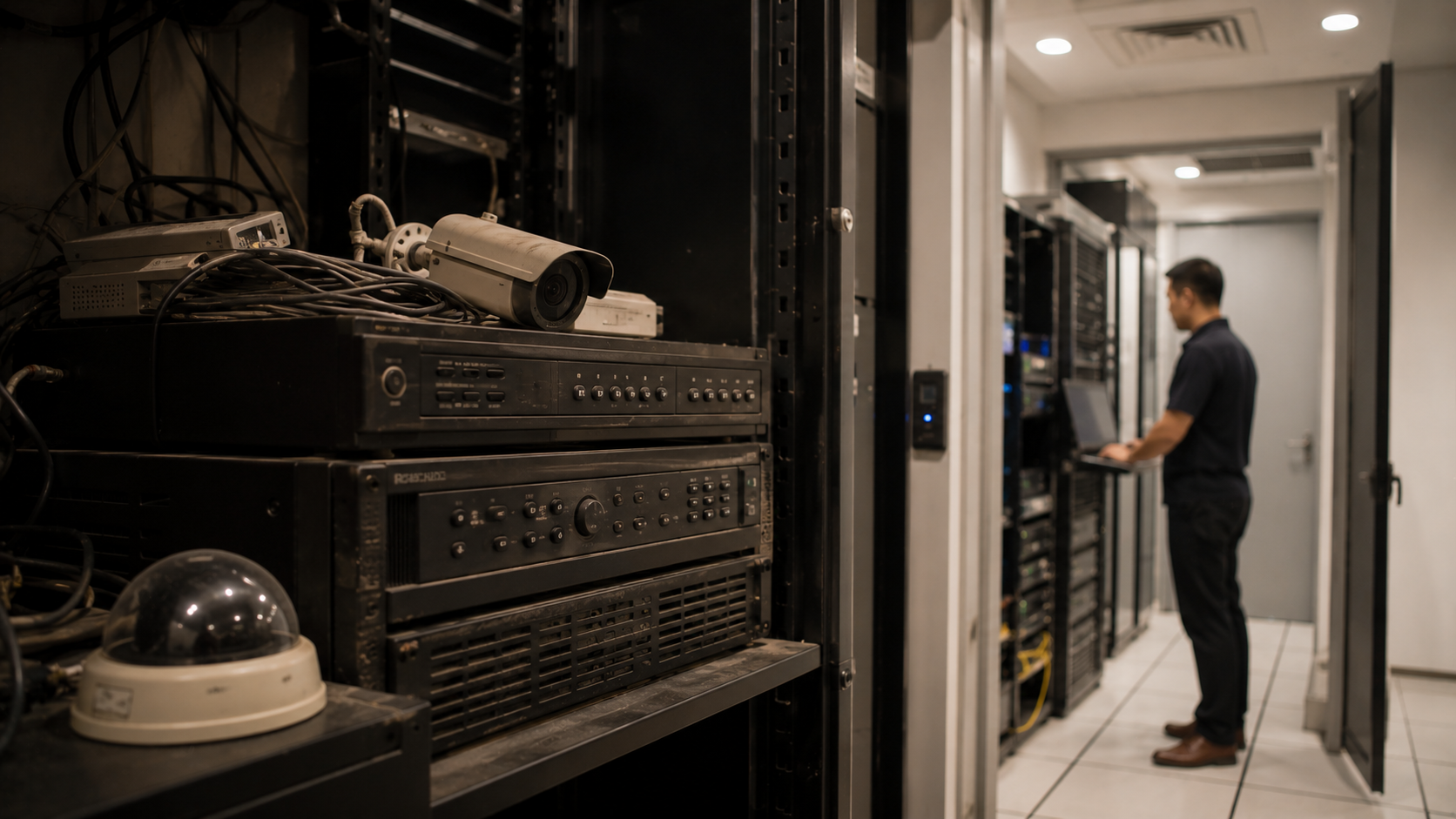
Not every room in a building carries the same security consequence.
A meeting room may be inconvenient to lose. A server room, Security Control Room, emergency power system or central utility plant may affect the operation of the entire facility if it is damaged, sabotaged or made unavailable.
The Guidelines for Enhancing Building Security in Singapore (GEBSS) therefore places particular emphasis on Critical Assets and Critical Utilities.
GEBSS defines Critical Assets as facilities, systems or equipment whose destruction, degradation or unavailability would affect the operation of the organisation or business. Examples given include the Security Control Room, Operations Command Centre, Building Maintenance Room, Fire Control Room, Data Centre and Server Room.
It also recognises that an asset can be critical because it represents a single point of failure, is difficult to replace or is essential to maintaining operations.
The important principle is:
Criticality should be determined by consequence, not simply by what the room is called.
What is a Critical Asset under GEBSS?
GEBSS defines a Critical Asset as a facility, system or item of equipment which, if destroyed, degraded or made unavailable, would affect the organisation or business.
Examples specifically identified by GEBSS are:
Security Control Room, Operations Command Centre, Building Maintenance Room, Fire Control Room, Data Centre and Server Room.
It also says that assets which are:
single points of failure, difficult to replace or essential to business operations
can be classified as Critical Assets.
This is broader than simply protecting expensive equipment.
Is a server room automatically a Critical Asset?
GEBSS lists a Server Room as an example of a Critical Asset.
However, the wider risk-management approach still matters.
Consultant’s perspective
Two server rooms may not have the same criticality.
One might support a small local function with full redundancy elsewhere.
Another might support:
building systems, business applications, security infrastructure or communications
with no immediate alternative.
The better question is therefore:
“What happens if this server room becomes unavailable?”
rather than simply:
“Is it called a server room?”
What is a single point of failure?
A single point of failure is an asset whose loss can cause a wider system or operation to fail because there is no effective alternative.
GEBSS specifically identifies single points of failure and assets that are difficult to replace as potentially Critical Assets.
Examples could include, depending on the building:
a central communications room, a main electrical system or a key security control function.
Those examples are applications of the GEBSS principle rather than a prescribed list.
Where should Critical Assets be located?
GEBSS says Critical Assets should be located:
away from road access and/or within specially protected areas.
It also says emergency water supply, fire-extinguishing systems, pumps and emergency electrical supply should be concealed to help prevent sabotage, with shielding or relocation away from public areas considered where appropriate.
Location itself is therefore part of the protection strategy.
A room exposed directly to:
a public car park, loading area or uncontrolled external route
may require more protection than the same asset positioned deeper within the building.
Should Critical Assets be placed next to public areas?
Where possible, GEBSS favours separating Critical Assets from potential threats and public access.
For central utility rooms, it specifically says they should be positioned away from public car parks and public areas. Where this cannot be achieved, additional physical protection may be necessary.
Consultant’s perspective
One of the first security questions during architectural planning should therefore be:
“What important rooms are we positioning around the public and vehicle-facing edges of the building?”
Moving a room can sometimes be more effective than attempting to harden it afterwards.
Are server rooms and utility rooms the same thing under GEBSS?
Not exactly.
GEBSS identifies Data Centres and Server Rooms as examples of Critical Assets.
Separately, it gives detailed guidance for central utility rooms supporting services such as:
water, electricity, communications and air-conditioning.
There may be overlap in practice, but the guidance should not automatically be treated as identical.
This distinction matters when interpreting technical recommendations.
Does GEBSS require CCTV and intrusion detection for every server room?
The source does not make that exact universal statement.
GEBSS identifies server rooms as potential Critical Assets, but its explicit statement requiring centralised monitoring by CCTV and intrusion detectors appears in the section dealing with central utility rooms.
Consultant’s perspective
CCTV, access control and intrusion detection may be highly appropriate for a Critical Asset such as a server room, depending on the Risk Assessment.
But it is better to say:
“The controls should reflect the assessed criticality and threat.”
rather than incorrectly claim:
“GEBSS universally requires this exact configuration for every server room.”
What does GEBSS say about central utility rooms?
GEBSS highlights central utilities because they may support many parts of the building and are connected through systems distributed throughout the facility.
The main utility functions it identifies as security-relevant are:
water, electricity, communications and air-conditioning.
It also recognises that utility ducts, pipes and supply channels could themselves be exploited during an attack.
This makes utility security both:
asset protection
and
protection of possible access or attack pathways.
How should central utility rooms be protected?
GEBSS says central utility rooms should be located well away from potential threats and not close to public car parks or public areas where practicable.
If this cannot be achieved, it discusses appropriate protection such as shielding against blast exposure.
GEBSS also states that entrances should be:
locked, controlled by access control and monitored from the control room by CCTV and intrusion detection.
This is considerably stronger than simply placing a mechanical-room key on a facilities key ring.
Does GEBSS recommend forced-entry protection for utility-room openings?
Yes.
For central utility rooms, GEBSS says windows and other openings, including ventilation and air-conditioning ducts, should be protected by forced-entry-resistant bars able to resist forced-entry attempts for at least five minutes.
It also recommends fitting those openings with detectors connected to an alarm system.
The key point is that the door should not be the only protected part of the room.
Does GEBSS require five-minute forced-entry resistance for every server room?
The cited GEBSS sections do not establish that as a universal rule for every server room.
The explicit five-minute guidance appears in relation to:
central utility-room openings, air-conditioning system openings and the water-treatment/purification arrangements discussed in those sections.
A server room is identified as a Critical Asset, but its detailed protection level should be established through the security risk assessment.
This distinction is important when preparing specifications.
Why do openings and ducts matter?
Because a protected room is only as effective as its accessible boundary.
A strong door may provide little value if a sufficiently large:
duct, ceiling void, service opening or other penetration
allows the protected space to be bypassed.
GEBSS repeatedly looks beyond conventional doors and windows when considering physical security.
Can utility pipes and ducts become security vulnerabilities?
Yes.
GEBSS specifically discusses:
ducts, channels, utility openings, drains and sewerage infrastructure.
It says these may potentially be used to gain access to a facility or introduce explosive devices or hazardous materials.
If a utility penetration creates a gap through the perimeter or building envelope, GEBSS says a comparable level of protection should be considered so the penetration does not become an exploitable weak point.
How can infrastructure openings be protected?
GEBSS discusses controls such as:
forced-entry-resistant mesh or steel grilles, securing manhole covers and potentially adding intrusion detection with visual surveillance where justified by building sensitivity.
The exact method depends on the type and purpose of the opening.
Consultant’s perspective
A useful design principle is:
Any penetration through a protected boundary should be reviewed to see whether it creates an easier route than the door you spent money protecting.
Should roof access also be considered?
Yes.
GEBSS specifically identifies roofs, ceilings, floors and infrastructure pipes as potential alternative access points.
It recommends restricting roof access and protecting service openings with suitable bars or grilles where appropriate. It also identifies roof glazing and skylights as potential weak points that may be exploited for unauthorised entry or introduction of other threats.
The security boundary should therefore be considered in three dimensions.
What does GEBSS say about Critical Utilities?
GEBSS recognises that some utilities are essential not just for normal building operation but also for:
evacuation and emergency response.
Their loss can therefore amplify the impact of an incident.
For example, GEBSS notes that the failure of fire-extinguishing or smoke-ventilation systems following an explosion could cause consequences greater than the immediate blast itself.
This is why Critical Utilities deserve protection even when they are not normally thought of as “security systems”.
Where should Critical Utilities be located?
GEBSS recommends, as far as possible, that Critical Utilities be:
underground, concealed and protected.
It also recommends redundancy for life-saving utility systems.
Other guidance includes protecting water-treatment plants and storage tanks by securing access points such as manholes, and positioning main fuel storage away from easily accessible areas.
Should Critical Utilities have redundancy?
GEBSS specifically says there should be redundancy to life-saving utility systems.
This introduces an important distinction between:
protecting an asset
and
making the operation resilient if that asset fails.
A highly protected system may still fail.
Redundancy can prevent one successful attack, technical fault or other loss from creating a complete failure of the building’s essential function.
Should critical utility routes run along external walls?
GEBSS recommends that incoming utilities be concealed within building and property lines.
It also says Critical or fragile utilities should not, where possible, be routed along exterior walls or walls shared with higher-risk functions such as mailrooms and loading docks.
This again shows that physical security can be influenced significantly by routing and architecture, not just by security equipment.
What about utility tunnels and crawl spaces?
GEBSS says access to:
crawl spaces, utility tunnels and other areas beneath buildings
should be controlled to reduce opportunities for an attacker to exploit these locations.
It also says utility penetrations through perimeter structures should be sealed or secured so that they do not create openings large enough for an intruder to cross the boundary.
These are easy areas to overlook because they are normally designed around maintenance rather than security.
Why does GEBSS pay special attention to air-conditioning systems?
A central HVAC system can affect large portions of a building.
GEBSS specifically considers the possibility of an adversary using a central air-conditioning system to introduce chemical or biological agents into the building environment.
Its discussion relates to central systems found in larger buildings rather than small individual room systems.
Where should fresh-air intakes be located?
GEBSS says fresh-air intake vents should be positioned as high as possible so they are not readily accessible to the public.
It also says they should be located so that access is difficult and so an object cannot readily be thrown into them from a distance of at least 10 metres. It recommends placing collections of intakes on a privately protected roof where practicable.
This is a specific GEBSS design consideration rather than a generic statement about every individual air-conditioning unit.
Should HVAC openings have forced-entry protection?
GEBSS discusses protecting air pipes, intakes and exhaust openings with forced-entry-resistant bars or mesh providing a minimum five-minute resistance level.
It also recommends detectors connected to an alarm system and making provision for future toxic or biological/chemical detection.
Again, the focus is on central building systems that could affect the wider facility.
Can the HVAC system be shut down during a chemical or biological incident?
GEBSS discusses providing valves or shutters capable of closing the main fresh-air intake and individual intake/exhaust paths.
These can be activated automatically or manually from the security or operational control room if smoke or biological/chemical contamination is detected.
It also discusses allowing for future air-filtration capability.
This demonstrates why physical security sometimes needs to interface with building mechanical systems.
Is HVAC control a security issue or an M&E issue?
It can be both.
The mechanical engineer designs and operates the ventilation system.
But if the system can be exploited as an attack pathway or needs to be controlled during a security incident, it also becomes part of the security response architecture.
Consultant’s perspective
This is a good example of why security design cannot be carried out entirely within the security contractor’s drawings.
It may require coordination between:
security, M&E, architecture and building operations.
Why are water tanks treated as a security concern?
GEBSS identifies intentional contamination as a threat to the building’s water supply.
It notes that sabotage could occur through the water infrastructure or directly through reservoir tanks.
Because water can affect a large number of occupants, unauthorised access to the water system can create consequences far beyond the tank room itself.
How should drinking-water tanks be secured?
Within its discussion, GEBSS states that drinking-water tanks and associated equipment are to be protected from unauthorised access and housed within a secured and locked dedicated tank/pump room or other secured enclosure.
GEBSS attributes those requirements to Singapore water-supply legislation and standards.
Since this article is an insight into the GEBSS document rather than an independent legal review, the current statutory requirements should be verified separately where legal compliance is being determined.
What additional protection does GEBSS discuss for water systems?
GEBSS discusses:
forced-entry-resistant protection for tank-room entrances and openings, protection of main valves and the use of detectors to raise security alerts if an intrusion or break-in is attempted.
For water-treatment or purification facilities, it also discusses:
five-minute forced-entry resistance, access control at the door and unauthorised-entry detection.
Does GEBSS discuss chemical or biological detection in the water system?
Yes.
The guideline recommends making provision for toxicity and biological/chemical detection, potentially integrated with water-purification detection.
It suggests monitoring around the main incoming water supply and the water leaving the tank for building distribution.
Whether and how that is implemented would depend on the facility and applicable security requirement.
What about emergency power?
GEBSS includes emergency electricity supply among infrastructure that should be concealed to reduce the possibility of sabotage.
Its Critical Utilities discussion also promotes the broader ideas of:
protection, concealment and redundancy
for important building services.
Consultant’s perspective
Protecting the main security system but leaving its essential supporting power infrastructure easily accessible would create an obvious dependency.
A security review should therefore consider what other systems the security controls depend on.
What about communications rooms?
GEBSS identifies communications as one of the principal central utility functions of security interest.
It does not provide a separate universal communications-room configuration in the cited section.
However, where communications support Critical Assets or emergency functions, their criticality and appropriate protection should be assessed through the same risk-management process.
Should utility security include CCTV?
For central utility rooms, GEBSS specifically says the room should be monitored from the control room by CCTV and intrusion detectors.
This is a source-specific statement for those central utility rooms.
It should not automatically be expanded into:
“GEBSS requires CCTV inside every electrical cupboard.”
The location, facility type and applicability of the guidance still matter.
Should utility-room access be restricted to authorised personnel?
Yes.
GEBSS says utility-room entrances should be locked and access controlled, and it specifically states that areas containing drinking-water supply lines, tanks and filtration systems should remain locked with access limited to authorised personnel.
This reflects the Deny layer of GEBSS’s Defence-in-Depth approach.
Should a Critical Asset be protected only at the room door?
No.
One of the strongest themes in GEBSS is that protection should consider the entire route to the asset and the full protective boundary.
A room may be reached through:
the normal door, adjacent spaces, ceilings, roofs, utility openings, service ducts or other penetrations.
GEBSS expressly says that roofs, ceilings, floors and infrastructure pipes should be considered alongside doors and windows when examining unauthorised access.
How should a Critical Asset be reviewed using layered security?
A practical review could look at:
Security Layer | Critical Asset Question |
|---|---|
Deter | Is the asset unnecessarily visible or obviously accessible? |
Detect | How would an attempted intrusion or sabotage be identified? |
Delay | How long would the physical room boundary slow an attacker? |
Deny | Who is authorised to access the room and how is this controlled? |
Respond | Who receives the alarm and can they act before the asset is compromised? |
Resilience | Is there redundancy if the asset nevertheless becomes unavailable? |
The first five reflect the GEBSS layered-protection model. The explicit resilience row is a consultant’s way of applying GEBSS’s separate emphasis on redundancy for important utilities.
Common misunderstandings about Critical Assets and utility security
“Every expensive room is a Critical Asset.”
Not necessarily. GEBSS focuses on operational impact, essentiality, single points of failure and replacement difficulty.
“Every server room must have exactly the same security controls.”
The GEBSS source does not establish one universal server-room configuration. Protection should follow the Risk Assessment and required protection level.
“GEBSS requires five-minute forced-entry resistance for every server-room door.”
The cited five-minute requirements occur in specific central utility, HVAC and water-system guidance. They should not be silently generalised to all server rooms.
“If the room door is strong, the asset is secure.”
No. GEBSS also considers roofs, ceilings, floors, ducts and utility penetrations as potential routes of entry.
“Utilities are only a facilities-management issue.”
No. GEBSS specifically treats water, electricity, communications and air-conditioning as security-relevant central utilities.
“The HVAC system has nothing to do with physical security.”
GEBSS explicitly considers the possibility of central air-conditioning being exploited to introduce chemical or biological agents.
“A service duct is too small to matter.”
Potential openings need to be assessed. GEBSS specifically warns that infrastructure pipes and openings can create exploitable gaps through a protected boundary.
Practical GEBSS Critical Asset Review
For each important room, system or utility, a project team should be able to answer:
- What business or building function does this asset support?
- What happens if it is destroyed, sabotaged or unavailable?
- Is there effective redundancy?
- Is it a single point of failure?
- Is the asset unnecessarily close to public or vehicle-accessible areas?
- Can it be relocated deeper into the building or otherwise concealed?
- Who genuinely requires access?
- Is access restricted and monitored appropriately?
- Does the room have alternative accessible openings?
- Can it be reached through ceilings, roofs, ducts or service penetrations?
- How would unauthorised access be detected?
- Can the security team identify exactly which room or opening is under attack?
- Does the physical boundary provide sufficient delay for the expected response?
- Are supporting utilities themselves protected?
- Can a failure of power, communications, water or HVAC disable a wider security or life-safety function?
- Are emergency-response systems dependent on the same vulnerable utility?
- Are utility routes unnecessarily exposed to external walls, loading docks or public areas?
- Are water, ventilation or utility systems vulnerable to intentional contamination or sabotage?
- What happens if the primary protection fails?
- Is the remaining risk acceptable after mitigation?
This is a consultant’s review framework based on GEBSS principles rather than a formal checklist published by GEBSS.
Conclusion
GEBSS takes a consequence-based approach to Critical Assets.
A room or system deserves stronger protection not merely because it contains expensive equipment, but because its loss could affect:
business operations, building safety, emergency response or the wider facility.
GEBSS specifically identifies Server Rooms, Data Centres, Security Control Rooms, Operations Command Centres, Building Maintenance Rooms and Fire Control Rooms as examples of Critical Assets.
It then extends the security problem into essential building infrastructure, including:
water, electricity, communications and air-conditioning.
The security strategy is therefore not simply:
“Put access control on the server-room door.”
It is:
Identify what the building depends on, understand how that asset could be reached or disrupted, protect the complete boundary and supporting infrastructure, detect an attack early, provide enough delay for response, and build resilience where one failure could affect the whole operation.
From Manpower to Managed Security. One operator, total accountability.
Company
Resources