
Building Security Operations: How Technology, Remote Monitoring and On-Site Security Work Together
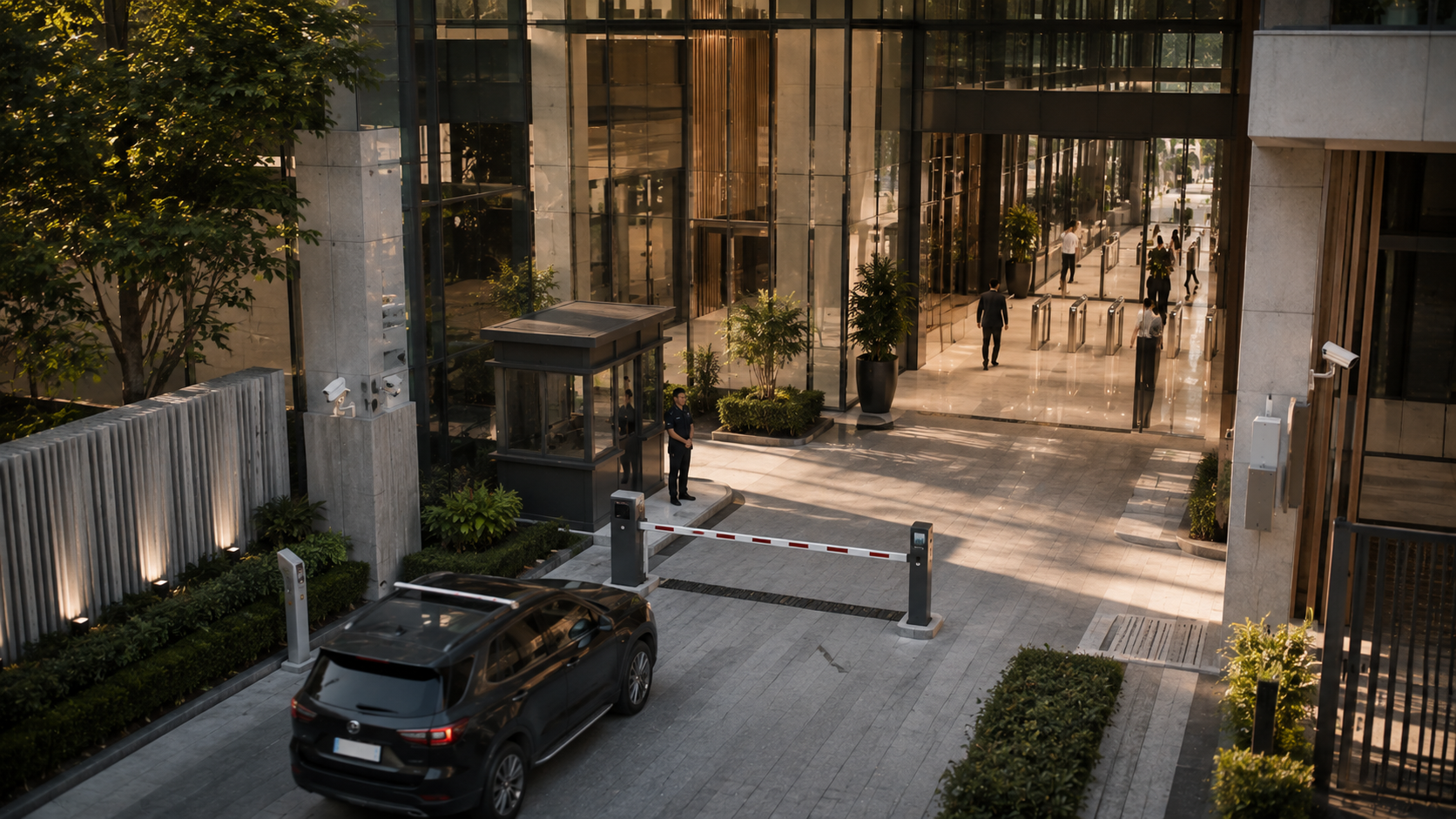
A modern building security operation should not rely on technology or security officers alone.
The stronger model combines:
security technology + remote monitoring + on-site response + maintenance + management oversight
into one coordinated operation.
Technology can perform many repetitive functions such as controlling access, detecting abnormal events and providing video verification. Remote security personnel can monitor multiple locations, assess alarms and coordinate responses. On-site personnel remain important where physical intervention, emergency response, customer interaction or site-specific duties require a person to be present.
The objective is therefore not:
“How many guards can we replace?”
It is:
“What is the most effective way to perform every security function at this property?”
That is the basis of a managed security operating model.
What is Building Security Operations?
Building security operations refers to the day-to-day system used to protect a property, its occupants and its assets.
It includes much more than the equipment installed in the building.
A security operation may involve:
- CCTV;
- access control;
- intrusion detection;
- intercoms;
- visitor management;
- security officers;
- remote monitoring;
- incident response;
- patrols;
- system maintenance;
- escalation procedures;
- reporting;
- management review.
The important word is:
operation.
A camera installed on a wall is equipment.
A camera that generates useful information, is monitored appropriately, remains operational, supports incident verification and forms part of an agreed response process is part of a security operation.
The same applies to access control.
A card reader controls a door.
But the wider security operation determines:
who receives access, who reviews unusual events, what happens when a door is forced, who maintains the system and who responds if an incident occurs.
What is Managed Security?
Managed security is an operating model in which a security provider takes responsibility for managing multiple parts of the client’s physical-security environment as an ongoing service.
Depending on the site and agreed scope, this can combine:
Security assessment and planning
↓
Technology design
↓
Supply and installation
↓
System integration
↓
Remote monitoring
↓
On-site security where required
↓
Maintenance and technical support
↓
Incident reporting
↓
Performance review and improvement
This is different from purchasing separate services from multiple suppliers and expecting the building owner or Managing Agent to coordinate everything.
How is Managed Security Different from Hiring a Security Guard Company?
Traditional guarding starts primarily with:
people.
For example:
One officer at the gate.
One officer at the lobby.
One officer in the security room.
One patrolling officer.
A managed security model starts with:
functions.
Instead of immediately asking how many officers are required, the security operation asks:
What must happen at the gate?
What must happen at the lobby?
What must be monitored?
Which events require human judgement?
Which tasks can technology perform reliably?
Which functions can be centralised?
What physical response capability is required?
Manpower is then deployed where a person genuinely adds value.
This does not mean eliminating security officers.
It means designing their role as part of a broader security system.
How is Managed Security Different from Using a Security Systems Integrator?
A systems integrator typically focuses on:
designing, supplying, installing and supporting security technology.
That may include:
CCTV, access control, intrusion detection, intercoms and other security systems.
Those are important functions.
But once installation is completed, somebody still needs to manage:
- alarms;
- incidents;
- user administration;
- system health;
- maintenance;
- response procedures;
- operator performance;
- recurring problems;
- security-service reviews.
A managed security provider therefore goes beyond:
“We installed the system.”
The question becomes:
“How is the system contributing to the security operation every day?”
Is Managed Security the Same as Remote CCTV Monitoring?
No.
Remote CCTV monitoring can form part of managed security, but it is only one component.
A complete managed security service may include:
security technology
remote event monitoring
on-site response
access management
intrusion monitoring
incident escalation
maintenance
reporting
and
ongoing security review.
Simply sending camera images to a remote control room is not, by itself, a complete managed security model.
The Three Main Parts of a Modern Security Operation
A useful way to understand the model is:
- Technology
Technology performs repeatable security functions.
Examples:
- access control;
- CCTV;
- intrusion detection;
- intercom;
- perimeter detection;
- visitor management;
- system-health monitoring.
Technology provides:
control, detection and information.
- Remote Security Operations
A remote monitoring centre or GSOC can provide functions such as:
- receiving security events;
- reviewing associated CCTV;
- communicating with occupants or site personnel;
- monitoring multiple sites;
- coordinating escalation;
- recording incident actions;
- identifying system faults.
Remote operations provide:
centralised awareness and decision support.
- On-Site Security and Response
Some security functions still require a person physically at the property.
Examples may include:
- responding to an incident;
- dealing with aggressive or unauthorised persons;
- assisting during emergencies;
- conducting selected physical patrols;
- managing unusual deliveries;
- supporting residents, tenants or visitors;
- investigating conditions that cannot be confirmed remotely.
On-site personnel provide:
physical presence, intervention and local judgement.
Remote, On-Site or Hybrid Security?
There are three broad operating models.
Model | Typical Approach |
|---|---|
On-site | Most monitoring and response performed by personnel at the property |
Remote | Significant monitoring and verification performed from a remote security operation |
Hybrid | Technology and remote monitoring combined with selected on-site personnel |
For many buildings, the hybrid model is particularly useful.
It allows routine monitoring and repetitive functions to be centralised while retaining people where local response or human interaction remains important.
What Security Functions Can Be Performed by Technology?
Technology is particularly effective at functions that are:
repetitive
rules-based
continuous
and
measurable.
Examples include:
Access Control
Instead of a person manually recognising every employee or resident, the access-control system can determine whether an authorised credential is valid.
Door Monitoring
The system can identify when a secured door:
is forced open
or
remains open longer than expected.
Intrusion Detection
Sensors can monitor:
restricted areas, perimeter locations and selected rooms
without requiring an officer to continuously observe them physically.
CCTV Recording
CCTV can provide continuous visual evidence across many locations simultaneously.
Video Analytics
Where appropriately designed, analytics can help identify particular events or conditions for operator attention.
Intercom
Remote personnel can communicate with visitors or contractors before granting access where this is operationally suitable.
System Health
Modern systems can identify conditions such as:
camera offline, recorder fault or controller communication failure.
Technology is therefore very good at:
watching consistently.
What is Technology Not Good At?
Security technology has limits.
It may identify:
a person entered an area.
But it may not understand:
why the person is there.
It may identify:
someone standing near an entrance.
But it may not automatically understand whether the person is:
waiting for a resident, delivering food, behaving suspiciously or experiencing a medical problem.
Technology can provide information.
Human judgement is often still needed to interpret that information.
And if physical intervention is required, someone ultimately needs to respond.
What Should Remain On-Site?
This depends on the property.
There is no universal rule that every site needs:
one guard, two guards or no guards.
Functions that may justify an on-site presence include:
- physical incident response;
- emergency support;
- enforcement of property rules;
- high visitor volume;
- vehicle management;
- concierge-type duties;
- handling complex contractors;
- resident or tenant assistance;
- safety-related support;
- unpredictable human situations.
The important point is:
A person’s presence should solve a defined operational requirement.
Not simply:
“There has always been a guard sitting here.”
What Functions Can Be Centralised?
Centralisation is one of the major advantages of modern managed security.
Instead of every property having personnel continuously watching separate screens, selected functions can potentially be managed centrally.
Examples include:
- alarm monitoring;
- CCTV event verification;
- after-hours monitoring;
- intercom handling;
- selected remote access requests;
- system-health monitoring;
- incident escalation;
- multi-site monitoring.
This can be particularly useful for organisations managing:
multiple offices, condominium developments, commercial buildings, industrial locations or retail sites.
What Does a GSOC Do?
A Global Security Operations Centre, or GSOC, is a central location used to monitor and coordinate security operations across one or more sites.
The exact scope varies significantly.
A GSOC may perform functions including:
- receiving security events;
- reviewing CCTV;
- monitoring access-control alarms;
- handling intrusion events;
- communicating with sites;
- coordinating response;
- tracking incidents;
- monitoring technology health;
- producing operational reports.
A GSOC should not simply be imagined as:
a room full of people staring continuously at hundreds of cameras.
A more effective model is usually event-driven.
Technology identifies conditions requiring attention.
Operators then focus on:
the events that matter.
Why Continuous Human CCTV Watching Has Limitations
A person staring continuously at multiple CCTV screens can miss events.
The problem becomes more significant as the number of cameras increases.
For example, an operator may technically have access to:
100 cameras.
That does not mean the operator is meaningfully observing:
100 scenes simultaneously.
A modern operating model therefore increasingly uses:
technology to identify an event
and
people to investigate the event.
That is very different from expecting somebody to watch every camera continuously.
What Does Event-Driven Security Mean?
Event-driven security means the operator’s attention is directed by meaningful events rather than relying entirely on continuous manual observation.
For example:
Normal condition
Carpark camera records continuously.
No operator attention required.
Event
Intrusion sensor activates after hours.
Security operation
Relevant camera is presented for review.
The operator then determines whether further action is required.
The technology performs:
detection.
The operator performs:
verification and judgement.
How Could This Work in a Condominium?
Consider a residential development managed by an MCST and Managing Agent.
A traditional security operation might include officers responsible for:
- gatehouse duties;
- visitor access;
- CCTV;
- patrols;
- responding to residents;
- vehicle issues;
- contractor access;
- alarms.
Some of those functions require physical presence.
Others may potentially be supported or centralised using technology.
For example:
Resident access
Access control.
Visitor communication
Intercom or visitor-management system.
After-hours intrusion alarm
Remote monitoring.
CCTV review
Event-driven monitoring.
Equipment faults
Remote system-health monitoring.
Suspicious person
Remote verification followed by physical response if required.
Resident requiring immediate assistance
On-site personnel may remain valuable.
The result may be a hybrid model rather than an entirely remote operation.
What About a Commercial Building?
A commercial building may have different priorities.
For example:
- tenant access;
- visitor registration;
- loading-bay security;
- contractors;
- after-hours access;
- critical plant rooms;
- carpark access;
- building management;
- emergency coordination.
The security model therefore needs to reflect:
how that particular building actually operates.
A residential condominium security model should not simply be copied into a commercial office tower.
What About an Industrial Facility?
Industrial sites may have additional requirements such as:
- larger perimeters;
- vehicle access;
- loading operations;
- restricted production areas;
- hazardous areas;
- contractor movements;
- valuable inventory;
- after-hours operations.
Remote monitoring may be particularly useful across large sites.
But physical response times and site-specific hazards become important considerations.
Again, the correct model is determined by operational needs.
What About Multi-Site Organisations?
Managed security becomes especially useful when an organisation operates many sites.
Without centralisation, each site may develop:
different alarm procedures, different technologies, different guard practices and different reporting methods.
A central managed model can provide:
- common escalation procedures;
- consistent incident reporting;
- central monitoring;
- common maintenance standards;
- technology standardisation;
- portfolio-wide visibility.
Individual sites can still retain different security measures based on their actual risk.
Who Should Manage the Different Parts of the Security Operation?
One advantage of defining the operating model clearly is that responsibilities can be assigned.
For example:
Function | Possible Responsible Party |
|---|---|
Security policy | Building owner / security management |
Day-to-day property management | Managing Agent / facilities team |
Security technology | Managed security provider |
Remote monitoring | GSOC / managed security provider |
Physical response | On-site security / response provider |
System maintenance | Managed security provider / specialist contractor |
Emergency services | Relevant authority |
Resident / tenant communication | Property management |
The exact allocation depends on the contract and property.
But it should be explicit.
What Should a Building Owner or MCST Still Control?
Outsourcing security does not mean the building owner gives away all responsibility for security decisions.
The owner, MCST or management team should normally remain involved in matters such as:
- security objectives;
- acceptable risk;
- access policies;
- resident or tenant requirements;
- budget;
- escalation expectations;
- major incidents;
- service performance.
The managed security provider operates within that agreed framework.
What Should the Managed Security Provider Be Responsible For?
Depending on scope, the provider may take responsibility for areas such as:
- security-system operation;
- system monitoring;
- maintenance coordination;
- event handling;
- escalation;
- incident reporting;
- system availability;
- user support;
- technology performance;
- periodic service review.
The important word is:
managed.
The client should know:
who owns each operational problem when something goes wrong.
Why Using Multiple Separate Contractors Can Create Gaps
Imagine a building has:
Company A for guards.
Company B for CCTV.
Company C for access control.
Company D for network support.
Company E for monitoring.
A Door Forced alarm occurs but no camera appears.
Who owns the issue?
The guard says:
CCTV problem.
CCTV contractor says:
camera is working.
Access-control contractor says:
alarm was generated.
Network contractor says:
network is online.
Monitoring company says:
integration did not present the video.
Every individual supplier may technically be correct.
But the security outcome failed.
One advantage of a managed operating model is creating clearer accountability across these interfaces.
Why Maintenance is Part of Security Operations
A building can have excellent security procedures and still become vulnerable if its technology gradually deteriorates.
For example:
Camera offline for two months.
Door contact permanently bypassed.
Intercom audio no longer works.
UPS battery failed.
Intrusion sensor generating constant false alarms.
If nobody manages these conditions, the system becomes weaker over time.
Maintenance therefore should not be treated as:
something the technician does once a year.
It is part of maintaining the security operation.
Preventive Maintenance and Operational Monitoring Are Different
Preventive Maintenance
Scheduled inspections and servicing.
Operational Monitoring
Identifying faults when they occur.
Both matter.
If a critical camera fails one week after preventive maintenance, waiting until the next scheduled visit is not a strong security model.
Where the technology supports it, system-health monitoring can allow earlier identification of faults.
Security Systems Should Be Managed According to Criticality
Not every device is equally important.
For example:
Camera A
General landscape overview.
Camera B
Only camera providing identification at the main entrance.
Both cameras are offline.
Should both faults have the same urgency?
Not necessarily.
A managed security operation can classify security assets according to operational importance so maintenance response reflects actual security impact.
What Happens if the Technology Fails?
This is one of the most important questions for any remotely supported security model.
The answer should not be:
“Hopefully it doesn’t.”
Buildings should have defined degraded operating modes.
For example:
CCTV temporarily unavailable
Does the site require additional physical patrols?
Remote monitoring connection unavailable
Does the site have local response capability?
Access-control server unavailable
Can local controllers continue operating?
Intercom unavailable
How are visitors handled temporarily?
Power failure
Which security functions continue?
The technical engineering of these failures belongs in our separate infrastructure guide.
Operationally, however, the site must know:
what to do while the technology is degraded.
Managed Security Does Not Mean Technology-Only Security
This distinction is important.
Managed security is not:
“Install technology and remove everybody.”
A mature model combines:
technology where technology performs best
with
people where people perform best.
Technology excels at:
- continuous detection;
- data logging;
- access decisions;
- event generation;
- recording;
- repetitive monitoring.
People excel at:
- judgement;
- communication;
- discretion;
- physical investigation;
- conflict management;
- emergency response.
Good security combines the two.
Should an MCST Replace All Security Officers with Remote Monitoring?
There is no universal answer.
The correct question is:
What functions are the officers currently performing, and which of those functions still require an on-site person?
For some properties, substantial functions may be centralised.
For others, resident interaction, traffic management, physical response or site complexity may justify continued manpower.
A security transformation should therefore begin with:
task analysis
rather than:
headcount reduction.
We explore that specifically in our separate guide:
How to Reduce Security Manpower Without Creating Security Gaps.
Can CCTV Replace Security Guards?
CCTV can perform functions that a security officer cannot perform continuously across an entire property.
For example:
it can record many areas at once and provide evidence later.
But CCTV cannot physically confront an intruder.
Similarly, an officer can investigate a suspicious situation physically but cannot personally observe every camera and doorway simultaneously.
They serve different purposes.
The better question is:
Which security function should be performed by CCTV, which by remote operators and which by on-site personnel?
Can AI Replace Security Officers?
AI and analytics can improve:
detection, filtering and event prioritisation.
But the security operation still needs to consider:
false positives, context, escalation and physical response.
For example, analytics may identify:
a person remaining in a restricted area.
The system still needs to determine:
Is the person authorised?
Is there a genuine security issue?
Does anybody need to respond?
AI can support the decision process.
It should not automatically be treated as a substitute for every human security function.
Should Security Monitoring Be 24/7?
That depends on the risk and operating requirement.
Some properties may require:
continuous monitoring.
Others may focus remote monitoring primarily on:
after-hours periods.
For example:
During business hours
On-site staff and security personnel are present.
After business hours
Remote monitoring becomes the primary security-monitoring function.
A hybrid schedule can sometimes provide better value than providing exactly the same security model 24 hours a day.
What About Properties That Already Have Security Officers?
Managed security does not require starting again from zero.
Existing manpower can be incorporated into the operating model.
For example:
instead of requiring the on-site officer to continuously watch CCTV,
the officer can focus on:
- physical response;
- patrol;
- residents;
- visitors;
- incidents.
Remote operators handle:
- selected alarm monitoring;
- event verification;
- after-hours monitoring;
- system faults.
This may make the existing officer more effective.
Security Officers Should Receive Better Information
Technology should improve the quality of the response.
A response officer receiving:
“Alarm somewhere at Block B.”
has limited information.
A better managed operation might provide:
Door Forced, Block B, Level 4 Electrical Room
plus:
relevant CCTV image
plus:
direction of travel
plus:
timestamp.
The officer now arrives with situational awareness.
That is a more effective use of manpower.
Building Security Should Be Proactive, Not Only Reactive
Many traditional security operations focus primarily on:
responding after an incident.
Managed security can also identify patterns before they develop into larger problems.
Examples might include:
- repeated Door Held events;
- repeated access-denied events;
- recurring intrusion alarms at one location;
- frequent camera outages;
- repeated tailgating;
- recurring unauthorised parking;
- repeated after-hours access.
One occurrence may be insignificant.
A pattern may reveal:
an operational weakness.
Security Data Should Lead to Improvement
Suppose monthly reporting shows:
90% of Door Held alarms occur at one loading-bay door.
The correct response may not be:
“Tell operators to keep acknowledging the alarm.”
The security team should investigate the reason.
Perhaps:
the door closer is defective.
Perhaps:
deliveries require longer opening periods.
Perhaps:
the alarm delay is inappropriate.
Perhaps:
staff are deliberately propping the door open.
The managed service should help identify:
root causes, not merely alarm counts.
What Should a Managed Security Report Show?
A useful periodic report could include:
Security incidents
What significant events occurred?
Alarm trends
Which alarms are recurring?
System health
Which devices had faults?
Response
Were incidents handled according to procedure?
Maintenance
What remains outstanding?
Access
Were unusual access patterns observed?
Improvements
What actions should be considered?
The report should help management make decisions rather than simply produce pages of raw system data.
What Should an MCST or Managing Agent Look for in a Managed Security Provider?
A provider should be able to explain more than:
what cameras it sells
or
how many guards it can deploy.
Useful questions include:
- How will you assess our current security operation?
- Which functions should remain on-site?
- Which functions can be remotely managed?
- How will existing systems be integrated?
- How will security events be monitored?
- Who responds after an event?
- What happens if remote connectivity fails?
- How will technology faults be identified?
- Who is responsible for maintenance?
- How will incidents be reported?
- How will service performance be measured?
- How frequently will the security model be reviewed?
- Can the system expand later?
- How do you prevent the technology and guarding functions from operating separately?
The answers reveal whether the proposal is genuinely a managed security model or simply a collection of products and manpower.
What Should Security Managers Look For?
Security managers may ask additional questions:
Can the operation provide consistent processes across multiple sites?
Are alarms prioritised according to risk?
Can events be verified before dispatch?
Are system faults monitored?
Can incident information be consolidated?
Are roles and escalation responsibilities clear?
Can security performance be measured?
Can operating procedures change as the risk changes?
The managed service should support the client’s security-management function rather than replace governance.
What Should Building Owners Look For?
Building owners are often concerned with:
- security effectiveness;
- cost;
- liability;
- tenant experience;
- property operations;
- technology lifecycle.
A strong security operation should therefore achieve more than crime deterrence.
It should also be:
reliable, manageable and financially sustainable.
A very expensive security model that cannot be maintained may not be sustainable.
A very cheap model that cannot respond effectively is not good value either.
The objective is:
appropriate security for the actual risk and operating environment.
What Should Managing Agents Look For?
Managing Agents often sit at the point where:
residents, owners, security contractors, maintenance contractors and technical systems
all meet.
The operating model should therefore reduce unnecessary complexity.
The MA should know clearly:
Who do I call if a camera fails?
Who handles an access-control fault?
Who receives security alarms?
Who dispatches a response?
Who reports incidents?
Who reviews recurring problems?
A well-managed service should make these responsibilities clearer, not more complicated.
A Simple Managed Security Model
A useful conceptual model is:
BUILDING / PROPERTY
|
v
SECURITY TECHNOLOGY
CCTV | ACS | IDS | INTERCOM
|
v
REMOTE SECURITY OPERATIONS
Monitor | Verify | Coordinate
|
+——————+
| |
v v
ON-SITE RESPONSE MANAGEMENT
Physical action Reporting
Human judgement Review
| |
+———+——–+
|
v
CONTINUOUS
IMPROVEMENT
The technology does not replace the operation.
It feeds the operation.
The Managed Security Lifecycle
A mature model follows a continuous cycle.
- Assess
Understand:
- threats;
- building operations;
- current systems;
- existing manpower;
- security gaps.
- Design
Determine the appropriate combination of:
technology, monitoring and physical response.
- Implement
Install, integrate and commission the required systems.
- Operate
Monitor events and support day-to-day security.
- Maintain
Keep systems operational.
- Review
Examine:
incidents, faults, alarm trends and operational changes.
- Improve
Adjust:
technology, procedures and manpower
where necessary.
Then the cycle repeats.
Common Mistakes in Building Security Operations
Treating security as purely a manpower problem
More guards do not automatically mean better security.
Treating security as purely a technology problem
More cameras do not automatically mean better security either.
Buying technology without defining who monitors it
An alarm that nobody receives has little operational value.
Installing systems without defining response
Detection is only the start of the security process.
Expecting one officer to watch dozens of cameras continuously
Theoretical access to cameras is not the same as meaningful monitoring.
Keeping guard posts simply because they have always existed
Each post should perform a defined security or operational function.
Removing manpower without understanding those functions
This can create genuine security gaps.
Using remote monitoring without planning for connectivity failure
Every remote service needs a degraded operating mode.
Separating maintenance from operations
An unavailable security system cannot perform its operational role.
Receiving hundreds of alarms but learning nothing from them
Recurring alarms should lead to root-cause analysis and improvement.
Managing every contractor separately with no overall accountability
Someone must be responsible for the complete security outcome.
What Does Good Building Security Look Like?
A well-managed building security operation should allow management to answer:
What are we protecting?
How do we detect something unusual?
Who receives that information?
Who determines what it means?
Who responds?
What happens if the technology fails?
Who maintains the system?
How do we know the service is performing?
What are we learning from incidents and alarms?
If these questions have no clear answers, the building may have security equipment and security officers without having a truly managed security operation.
A Practical Review for Building Owners, MCSTs and Managing Agents
Before renewing or redesigning a security contract, consider:
Question | Why It Matters |
|---|---|
What does each security officer actually do? | Reveals where manpower is genuinely required |
Which duties can technology support? | Identifies opportunities for improvement |
Which events are currently monitored? | Shows whether detection leads to action |
Who monitors after hours? | Tests continuity of security |
Can events be remotely verified? | Can reduce unnecessary responses |
Who physically responds? | Remote monitoring alone cannot intervene |
Are security systems monitored for faults? | Prevents unnoticed degradation |
Who maintains the systems? | Establishes technical accountability |
What happens during Internet or power failure? | Tests operational resilience |
Are recurring incidents analysed? | Turns security data into improvement |
Are reports useful to management? | Avoids meaningless statistics |
Is the security model periodically reviewed? | Building risks and operations change |
Managed Security is About Outcomes
A traditional tender may separate security into:
guarding contract
and
security system contract.
A managed security approach instead begins with:
What security outcome does the property need?
The answer may involve:
technology.
It may involve:
remote monitoring.
It may involve:
on-site security personnel.
In many cases, it will involve all three.
The correct combination depends on:
the building, its users, its threats, its operating hours and its response requirements.
Conclusion
Modern building security should not be viewed as a choice between:
people
or
technology.
The stronger model uses each where it performs best.
Technology provides:
continuous control, detection, recording and information.
Remote security operations provide:
centralised monitoring, verification and coordination.
On-site personnel provide:
physical presence, judgement and response.
Maintenance keeps the technology capable of performing its role.
Management oversight ensures the entire operation remains aligned with the property’s risks.
The result is not simply:
a CCTV system
or
a guarding service.
It is a managed security operation.
For building owners, MCSTs, Managing Agents and security managers, the key question should therefore be:
Are we paying for individual security resources, or do those resources actually work together as one coordinated security operation?
For PATH, this is the distinction at the centre of the service model:
consulting and planning + security technology and systems integration + remote security operations + appropriate on-site manpower + ongoing maintenance and improvement.
The objective is not technology for its own sake and not manpower reduction for its own sake.
It is to create a security operation that is:
effective, responsive, maintainable and appropriate for the property it protects.
From Manpower to Managed Security. One operator, total accountability.
Company
Resources