
Security Control Rooms, Integrated Security Systems and Emergency Communications under GEBSS
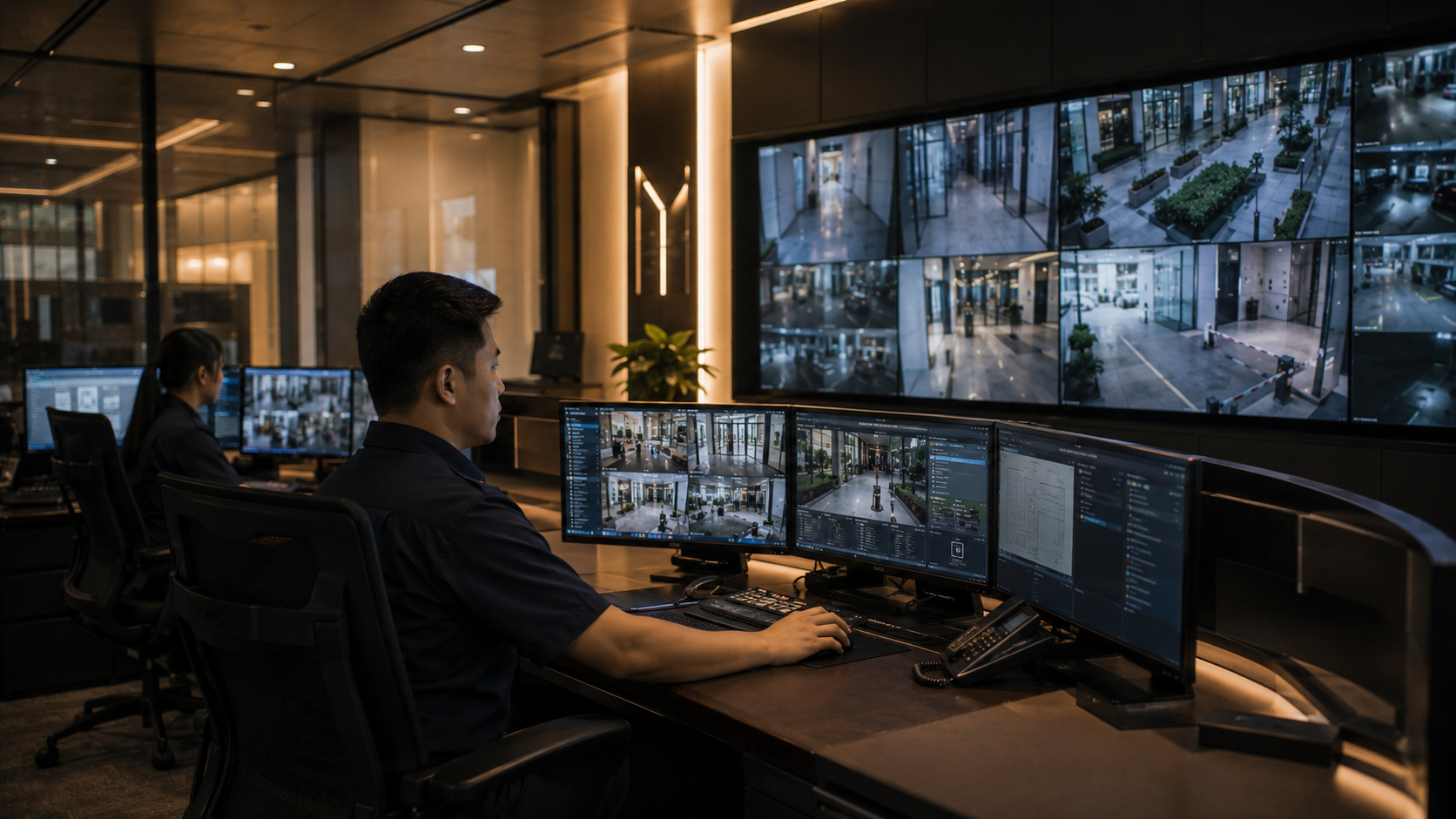
A building can contain excellent CCTV, access control and intrusion-detection systems and still perform poorly during a real incident if those systems do not provide the right information to the right people at the right time.
The Guidelines for Enhancing Building Security in Singapore (GEBSS) therefore places significant emphasis on the Security Control Room (SCR) and the integration of security systems.
GEBSS describes the Security Control Room as the building’s “nerve centre” of security operations. It should receive and provide critical information to security personnel, commanders, executives and first responders during both normal operations and emergencies.
The SCR is therefore not simply:
“the CCTV room.”
Its wider role is to create situational awareness, manage alarms, control security systems, communicate instructions and support an effective response.
The central principle is:
Security systems create value only when information can be understood, prioritised and converted into timely action.
What is a Security Control Room under GEBSS?
GEBSS describes the Security Control Room as the nerve centre of building security operations.
It should support communication and information exchange between:
security personnel, commanders, executives and first responders
during routine and emergency situations.
This means the SCR has both:
monitoring functions
and
command-and-response functions.
It is not intended merely as a place to display camera images.
Is a Security Control Room the same as a CCTV room?
Not under the GEBSS concept.
CCTV monitoring and recording are important parts of the SCR, but GEBSS envisages a much broader range of systems being available there.
These include:
CCTV monitoring and recording, alarms, pedestrian and vehicle access control, public-address functions, intercoms, fire detection, air-conditioning and mechanical ventilation, security lighting and lift systems.
A better description would therefore be:
an integrated security operations centre for the building.
What systems should be available in the Security Control Room?
GEBSS gives the following examples:
System | GEBSS Control Level |
|---|---|
CCTV monitors | Main |
CCTV recording | Main |
External direct telephone line | Main |
Alarm system | Main |
Pedestrian and vehicle access control | Main |
Public Address | Sub-station with overriding authority |
Intercom | Sub-station |
Fire detection | Sub-station |
Air-conditioning and mechanical ventilation | Sub-station with overriding authority |
Security lighting | Sub-station with overriding authority |
Lift system | Sub-station |
This reflects the system arrangement set out by GEBSS for the Security Control Room.
The exact operational authority over each system will depend on the building and applicable regulations, but the key GEBSS idea is that security operations need access to more than just electronic-security platforms.
Why would the Security Control Room need access to HVAC controls?
Because certain security incidents may require building mechanical systems to respond.
GEBSS specifically recommends connecting the SCR to critical or security-related building-management systems such as air-conditioning and mechanical ventilation, allowing security personnel to control or override them when required.
This connects with GEBSS’s separate discussion of chemical or biological threats, where ventilation systems can become important parts of the response.
Consultant’s perspective
This does not necessarily mean a security officer should have unrestricted control over every M&E system.
The important design question is:
Which building systems may need to be monitored or controlled during a security emergency, and what level of authority should the SCR have?
Why would the Security Control Room need access to lift systems?
GEBSS includes the lift system as a sub-station function within the Security Control Room.
The purpose is to provide greater operational awareness and potentially support emergency management.
The source does not prescribe one universal lift-control sequence for every security incident.
Any specific control logic would need to be coordinated with:
building operations, lift specialists, fire-safety requirements and the relevant emergency procedures.
What does “integration” mean in GEBSS?
GEBSS does not necessarily say that every building system must run on one software platform.
Instead, it repeatedly emphasises that systems should work together.
It states that security systems can be integrated with facilities-management systems for greater efficiency and that security systems should be planned as part of the overall building-security strategy.
Consultant’s perspective
There are several possible levels of integration.
For example:
Level 1 – Co-location
Operators have separate CCTV, access-control and alarm systems available in the same room.
Level 2 – Event association
An access-control or intrusion alarm automatically brings the relevant camera to the operator’s attention.
Level 3 – Coordinated response
A security event triggers or enables other predefined actions involving doors, lighting, communications or relevant building systems.
GEBSS establishes the integration principle; these levels are a practical consultant interpretation rather than GEBSS terminology.
Does everything need to be fully automated?
No such universal requirement appears in GEBSS.
The objective is not necessarily to automate every action.
The more important issue is whether the operator:
receives accurate information, understands what happened and can perform the required response efficiently.
For some functions, automation may help.
For others, manual confirmation may be appropriate.
The required workflow should follow the building’s Risk Assessment and operating procedures.
Why is situational awareness important?
GEBSS says the Security Control Room should have a clear situational picture.
That includes information about:
normal and abnormal activity, crowd concentrations and security incidents.
The SCR should also be able to prioritise information from cameras and alarm systems so operators can distinguish genuine incidents from false alarms.
This is one of the most important operational concepts in the guideline.
The purpose is not to give operators more information.
It is to give them useful information.
Can too many alarms become a security problem?
Yes.
Although GEBSS does not use the modern term “alarm fatigue” in this section, it specifically says the SCR needs to prioritise and filter information so genuine incidents can be differentiated from false alarms.
Consultant’s perspective
A control room receiving hundreds of poorly configured alarms can be less effective than one receiving a smaller number of meaningful, prioritised events.
Security-system design should therefore consider:
alarm classification, event priorities, clear descriptions and operator response procedures.
Should an alarm show exactly where the incident occurred?
Yes.
GEBSS says alarm indications transferred to the Security Control Room should identify the exact location of the breach or event as accurately as possible.
This is operationally important.
An alarm labelled:
“DOOR 47”
may mean little to an operator under pressure.
A more operationally useful description could identify:
building, floor, area and door.
That naming approach is consultant implementation advice, but it supports GEBSS’s requirement for accurate event location.
Should an alarm also bring up the relevant camera?
GEBSS says each alarm indication should be accompanied by a visual picture of the location where the breach or event is taking place.
This is a strong integration principle.
For example:
Door alarm → exact location displayed → associated camera shown → operator assesses incident → response initiated
That is much more useful than requiring an operator to receive an alarm, remember the camera number, manually search for it and then determine what happened.
Should CCTV and alarms be integrated?
GEBSS strongly supports this concept.
Its SCR guidance expects alarm events to be associated with visual information, while its broader layered-protection discussion encourages complementary technologies such as CCTV and intrusion detection.
The goal is:
Detection + assessment + response
rather than isolated security systems.
Does GEBSS give detailed CCTV specifications in the Security Control Room section?
No.
GEBSS expressly directs readers to the SPF Video Surveillance System Standard for Buildings for detailed VSS requirements, including video storage and related technical matters.
That fits our content structure well.
For the GEBSS Insights, the important issue is how surveillance supports the wider building-security operation.
Detailed matters such as:
resolution, frame rate, retention, Detect/Observe/Recognise/Identify and VSS cybersecurity
belong in our separate VSS Insights library.
Should the Security Control Room be a dedicated room?
Yes.
GEBSS recommends that the SCR be designed as a dedicated facility and specifically says it should not also perform a dual role such as functioning as the access-control guard post.
This is an important distinction.
The lobby security desk and the Security Control Room may both involve security officers, but their roles are different.
The lobby desk deals directly with people at the building entrance.
The SCR should maintain wider situational awareness and coordinate building security.
Can the guardhouse also be the Security Control Room?
GEBSS advises against this arrangement as a general design principle.
It recommends a dedicated SCR and separately says critical building-security controls should generally not be placed in an exposed perimeter or entrance security post unless that post itself has an adequate protection level.
Consultant’s perspective
Combining both functions can create several problems.
The operator may be distracted by:
visitor enquiries, deliveries, access requests and routine front-desk activity
while also being expected to monitor alarms and coordinate emergency response.
It can also place critical control functions closer to the external threat.
Is the Security Control Room itself a Critical Asset?
Yes.
GEBSS elsewhere specifically lists the Security Control Room as an example of a Critical Asset.
Its SCR design section therefore says the room should be adequately protected against expected threats, including examples such as:
forced entry, ballistic threats and explosives.
It also calls for access control and forced-entry protection at the SCR entrance.
This creates an important principle:
The systems protecting the building also need protection themselves.
Does every Security Control Room require ballistic and blast protection?
The source says the SCR must be adequately protected against the expected threats, giving forced entry, ballistics and explosives as examples.
It would therefore be incorrect to turn those examples into a universal statement that every ordinary commercial SCR must automatically have the same ballistic and blast rating.
The required protection level should follow:
the Risk Assessment, building type and relevant threat.
Should the SCR door have access control?
Yes.
GEBSS specifically says the Security Control Room entrance should have:
access control and forced-entry protection.
This reflects the room’s critical role.
Unauthorised access to the SCR could potentially affect several security and building-management systems at once.
Does the Security Control Room need backup power?
Yes.
GEBSS recommends:
emergency power, emergency lighting and backup of critical systems
so security operations can continue during emergencies, including power failures or situations where the SCR itself may be affected.
This follows an obvious operational principle:
The security system should not disappear when the building is under its greatest stress.
Does GEBSS specify how long the backup power must last?
The cited SCR section does not specify one universal backup duration.
It requires emergency power and backup arrangements, but the detailed runtime would need to be determined through:
system requirements, emergency power design and any applicable standards.
We should therefore not invent a universal GEBSS figure.
Does GEBSS recommend separate electrical circuits for the SCR?
Yes.
GEBSS recommends at least two separate power lines, with one dedicated to security systems and the other used for administrative equipment.
This reduces unnecessary dependency between operational security equipment and general administrative loads.
Does the SCR need a direct external telephone line?
Yes.
GEBSS recommends a dedicated direct external telephone line for the Security Control Room.
This provides a communication route independent of normal internal communication arrangements.
The document does not prescribe the detailed telecom architecture beyond this statement.
Why does GEBSS mention water pipes near the Security Control Room?
Because the SCR contains critical electronic equipment.
GEBSS advises avoiding water pipes near the control room and any adjoining equipment room.
Consultant’s perspective
This reflects a broader resilience principle:
Do not protect an important room from intruders while overlooking ordinary infrastructure that could disable it.
Security availability can be affected by:
water leakage, power loss, overheating or equipment-room failures
as well as malicious attacks.
Should the SCR equipment be in the same room as the operators?
Not necessarily.
GEBSS recommends that electrical equipment supporting the security-control systems be located, where appropriate, in a separate adjoining room with suitable climate control.
This can help separate:
operator activity
from
technical equipment infrastructure.
It may also simplify environmental management and maintenance.
What does GEBSS say about monitor positioning and lighting?
The control-room environment needs to support the operator.
GEBSS says lighting should not cause glare on monitors and working surfaces should be positioned so operators have a good view of the displays.
This may seem minor compared with barriers and access control, but poor ergonomics can reduce operator performance.
An SCR is a workplace as well as a security facility.
Should administrative work happen inside the SCR?
GEBSS allows for administrative functions but says an area should be designated so administrative activity does not interfere with security-control-room operations.
Consultant’s perspective
This reinforces the earlier point that the control room should not become:
a reception desk, storeroom, contractor meeting room and CCTV room
all at the same time.
The operational security function should remain the priority.
What is the role of intercom systems in building security?
GEBSS says intercom and similar communication systems play an important role in security, especially in relation to access control.
They allow personnel operating a gate or controlled door to communicate with someone requesting entry without leaving the relative protection of the secure side.
This supports both:
verification
and
security of the operator.
Should an intercom be combined with CCTV?
GEBSS recommends combining access-control intercom units with:
CCTV coverage and appropriate lighting.
This allows security personnel to assess incoming people more effectively.
This is a good example of simple security-system integration.
The intercom provides:
voice communication
while the camera provides:
visual assessment.
Why does intercom audio quality matter?
Because the system may operate in very different environments.
GEBSS says volume and background-noise filtering should consider:
the surrounding noise level and the distance of the person from the unit.
A street vehicle entrance may require different performance from a quiet internal pedestrian entrance.
Consultant’s perspective
A poorly designed intercom can undermine the entire access-control process if the guard and visitor cannot understand each other clearly.
Should drivers have to leave their vehicle to use the intercom?
GEBSS says vehicle-entry intercom units should be arranged so drivers do not need to get out of the vehicle to operate them.
It even gives the example of triggering the call system automatically as the vehicle approaches.
This improves both:
operational flow
and
security control at the vehicle entrance.
Does an intercom need vandal protection?
For external units, yes.
GEBSS says outdoor intercom equipment should be protected against:
temperature, humidity, rain and vandalism.
This is important because the communication device is itself exposed at the point where unauthorised people interact with the site.
What is the role of the Public Address system in security?
GEBSS says the Public Address (PA) system plays an essential role in emergency procedures because it can convey life-saving instructions to building occupants and the public.
It says the PA system should be integrated with the building’s intercom and security arrangements.
This moves the PA system beyond:
background music or routine announcements.
It becomes part of the building’s emergency response capability.
Should the Public Address system be controlled from the Security Control Room?
Yes.
GEBSS says the building should have a PA system that can be controlled from the Security Control Room.
It also says access should be available to the security manager’s office.
This allows emergency instructions to form part of the coordinated security response.
Should emergency messages be prerecorded?
GEBSS recommends prerecorded messages covering relevant response scenarios and the appropriate languages.
Consultant’s perspective
Prerecorded messages can help provide:
consistent wording, clear instructions and rapid communication
when operators are dealing with a stressful incident.
However, the organisation still needs procedures defining:
who is authorised to activate them and under what circumstances.
Does the PA system need complete building coverage?
GEBSS says speaker coverage should be complete and cover every room, and the system should be easy to operate during an emergency.
This is logical because an emergency communication system is of limited value if significant occupied areas cannot hear the instructions.
Any applicable fire or emergency communication standards should also be addressed separately.
Should security systems be planned during the architectural design stage?
Yes.
GEBSS specifically says security systems should be planned during the design phase of the building.
The reasons include better coordination between:
design, manpower and technology,
as well as reducing future retrofit cost and designing out security problems before they become operational issues.
This follows the wider GEBSS philosophy of security-by-design.
Can security technology reduce manpower requirements?
GEBSS says coordination between design, manpower and technology can potentially reduce operating costs by reducing security manpower requirements while improving security and reducing later retrofit costs.
However, this should not be simplified into:
“Install more technology and remove guards.”
The correct security arrangement still needs to follow the Risk Assessment and response requirement.
Technology can support or replace certain tasks, but the overall protective chain must remain effective.
How long does GEBSS expect security technology to last?
GEBSS notes that electronic security systems have a relatively short technological life compared with physical protective elements and says they may become technologically obsolete in not more than about 10 years.
It therefore recommends designing infrastructure so systems can be upgraded easily and modularly.
This is not necessarily a statement that every system physically fails after ten years.
It is about technology obsolescence.
What does “future-proofing” security systems mean?
It does not mean trying to predict exactly which camera, reader or software platform will exist ten years from now.
GEBSS’s principle is to provide infrastructure that makes future upgrades easier.
Consultant’s perspective
That may influence early decisions around:
containment, cable routes, equipment-room space, network infrastructure, rack capacity, electrical provision and physical space for later systems.
The goal is:
replace the technology without rebuilding the building.
Does GEBSS recommend modular systems?
Yes.
GEBSS says both its M&E/security planning and its security-system guidance should consider future:
upgrades, expansion and replacement.
It encourages modular and upgradeable arrangements with sufficient physical space for later changes.
This matters because security requirements can change before the building reaches the end of its useful life.
Should security systems integrate with facilities management?
GEBSS says security systems can be integrated with the building’s facilities-management systems for greater efficiency.
But integration should have a defined operational purpose.
Consultant’s perspective
Useful questions include:
Does the security operator need to see this information?
Does the SCR need monitoring only, or control authority?
What happens if one system fails?
Does integration create a new dependency?
Who is authorised to override a building system?
Integration should solve an operational problem rather than being done simply because two systems can technically communicate.
Is one giant integrated platform always better?
GEBSS does not say this.
Its emphasis is on coordinated systems and effective control.
There can be advantages to integration, but excessive dependence on one platform can also create:
complexity, maintenance dependencies or single points of failure.
The source does not provide a universal architecture for every building.
Therefore, the correct design should follow:
the building’s Risk Assessment, operational requirements and resilience needs.
How does an SCR support emergency response?
GEBSS gives three additional SCR functions:
communicating information to building occupants, assisting and monitoring evacuation, and supporting commanders, decision makers and first responders.
This makes the SCR a central coordination point during incidents.
It may help bring together:
camera information, alarms, access status, communications and selected building-system data
so those managing the incident have a clearer picture.
How would an integrated security response work in practice?
Consider an after-hours forced opening of an external door.
A well-designed workflow could be:
- Door detector activates.
The intrusion system identifies an abnormal opening. - SCR receives the alarm.
The event clearly identifies the exact location. - Relevant camera appears.
The operator receives visual information associated with the alarm. - Operator assesses the event.
The operator distinguishes a genuine intrusion from an authorised or false event. - Response is initiated.
Security personnel are deployed or escalation procedures begin. - Other systems may support the response.
Depending on the scenario, lighting, access control, communication or other authorised controls may be used.
This is a consultant’s example applying GEBSS principles rather than a prescribed GEBSS sequence.
What about an incident at the main entrance?
The same integration principle applies.
A security officer may use:
an intercom to communicate, CCTV to assess the person, access control to admit or deny entry, a duress alarm if threatened, and the SCR to coordinate the wider response.
The Public Address system may become relevant if instructions have to be communicated to occupants.
The value comes from the systems working together rather than each system existing independently.
What is the difference between monitoring and control authority?
This is an important distinction in the GEBSS SCR table.
Some systems are shown as main systems within the SCR.
Others are provided as sub-stations.
Some sub-stations may have overriding authority, while others may provide ordinary operating or monitoring capability.
Consultant’s perspective
For each connected building system, the design team should therefore decide:
Can the security operator only see it?
Can the security operator operate it?
Can the security operator override normal operation during an emergency?
These are different permissions and should be intentionally designed.
Should all alarms have the same priority?
GEBSS does not provide a universal alarm-priority matrix in this section.
However, it explicitly requires the SCR to prioritise and filter relevant information and distinguish genuine incidents from false alarms.
Consultant’s perspective
A useful control-room design should therefore distinguish between:
routine system events, faults, security warnings, urgent alarms and potentially life-safety-related events
according to the building’s operating procedures.
The exact priority categories would be a project-specific design decision.
What information should the operator receive during an alarm?
At minimum, GEBSS expects accurate location information and associated visual information where an alarm is transferred to the SCR.
A practical operator interface can therefore aim to answer:
What happened?
Where did it happen?
When did it happen?
What does the camera show?
What action is required?
The last two questions move the system from simply reporting events towards supporting an actual security response.
Should the Security Control Room be tested as an operational system?
GEBSS does not provide a detailed SCR commissioning procedure in the cited section.
However, the control room is intended to function during real routine and emergency situations.
Consultant’s perspective
It is therefore sensible to test not only individual devices but complete scenarios.
For example:
Door forced open → alarm received → exact location shown → correct camera displayed → operator acknowledges → response procedure initiated.
This is an application of the GEBSS integration philosophy, not a separately prescribed GEBSS testing method.
Practical GEBSS Security Control Room Review
A building owner or project team can review the SCR using the following structure:
Review Area | Key Question |
|---|---|
Role | Is the SCR a genuine security operations centre or only a CCTV viewing room? |
Location | Is it positioned and protected according to its importance? |
Access | Who can enter and how is entry controlled? |
CCTV | Can operators quickly see relevant incidents? |
Alarm management | Are alarms accurately located and prioritised? |
Integration | Does an alarm bring useful supporting information? |
Access control | Can appropriate pedestrian and vehicle access systems be managed? |
Intercom | Can security communicate without leaving the secure area? |
PA | Can emergency instructions be issued quickly? |
Building systems | Which systems require monitoring, control or override capability? |
Power | Can operations continue during power failure? |
Communications | Is an independent external communication path available? |
Ergonomics | Can operators work effectively without glare or obstructed displays? |
Equipment resilience | Are critical electronics and environmental risks properly managed? |
Future expansion | Can systems be upgraded without major reconstruction? |
This is a consultant’s review framework based on GEBSS rather than a prescribed GEBSS checklist.
Common misunderstandings about Security Control Rooms and system integration
“The SCR is basically a room for watching cameras.”
No. GEBSS envisages CCTV, alarms, access control, communications and selected building-management systems being coordinated through the SCR.
“More screens mean better security.”
Not necessarily. GEBSS emphasises prioritisation and a clear situational picture, not simply more information.
“Every alarm should just appear in the event log.”
GEBSS says alarm indications should identify the exact event location and be supported by visual information.
“The reception guard desk can also be the SCR.”
GEBSS recommends a dedicated Security Control Room rather than combining it with an access-control guard post.
“The SCR only needs normal building power.”
GEBSS specifically calls for emergency power, emergency lighting and backup of critical systems.
“All building systems must be fully controlled from the SCR.”
No. GEBSS distinguishes between main systems, sub-stations, monitoring capability and overriding authority.
“An intercom is just an administrative convenience.”
GEBSS expressly identifies intercoms as important to security, particularly access control.
“The PA system is mainly for announcements.”
GEBSS treats it as an essential emergency-response system capable of issuing potentially life-saving instructions.
“Security systems installed today can simply remain for the life of the building.”
GEBSS specifically recognises technological obsolescence and recommends modular, upgradeable infrastructure.
Conclusion
GEBSS treats the Security Control Room as the point where the building’s individual security layers become an operational security capability.
Cameras provide information.
Alarms identify abnormal events.
Access control manages movement.
Intercoms allow security personnel to communicate while remaining protected.
Public-address systems communicate emergency instructions.
Selected building systems provide additional information or control during incidents.
The Security Control Room brings these functions together so operators can:
Detect → Assess → Decide → Communicate → Respond.
That sequence is a practical interpretation of the GEBSS operating philosophy.
The most important lesson is:
A security system is not truly integrated because several products are connected to the same network. It is integrated when the right event reaches the right operator, with enough information and control to make an effective response.
GEBSS therefore calls for security systems to be considered during the building’s design stage, integrated with relevant building functions, backed by resilient infrastructure and designed for future replacement as technology changes.
From Manpower to Managed Security. One operator, total accountability.
Company
Resources